Shopify vs WooCommerce Cost (2026): Three Store Sizes, Year One vs Year Three
Is WooCommerce cheaper than Shopify? On the bill, yes, but by less than most comparisons claim, and the gap shrinks after year one. Both platforms charge the same 2.9% + $0.30 for a US card, so the cost difference comes down to Shopify's $29 plan against your WooCommerce hosting. At October 2026 prices, that leaves WooCommerce about $26 a month cheaper in year one and about $11 a month cheaper once the hosting renews. Price in even a quarter of an hour of maintenance a month and the saving is gone.
So WooCommerce suits owners who already have a maintainer, or who need what only an owned store gives: any gateway without a penalty, total control and an exit. Shopify suits everyone else, and the case for it is clearest at the hobby end, where WooCommerce's saving is too small to pay for the time. Figures below are US prices read on Shopify's, WooPayments' and SiteGround's own pages on 9 and 10 October 2026.
The verdict in one line per store size
- Hobby store, $500 a month: Shopify Basic costs $558 a year; WooCommerce costs $245.88 in year one and $425.88 in year three. Woo saves $132.12 a year once renewed, which about two and a half hours of upkeep a year at $50 would erase.
- Standard store, $2,000 a month and 40 orders: Shopify $1,188 a year; WooCommerce $875.88 in year one, $1,055.88 in year three. The same $132.12 annual gap, because processing costs the same on both.
- Growing store, $10,000 a month and 200 orders: Shopify $4,548; WooCommerce $4,259.88 in year one and $4,559.88 in year three on a bigger hosting plan. Renewed, Woo costs $11.88 a year more before any maintenance.
The surprise in those lines is that store size barely matters. Processing is identical on both platforms, so it cancels out. What is left is a plan fee against a hosting fee, and both are fixed.
The structural cost, itemized
The Shopify side of the ledger is short. Basic costs $29 a month on yearly billing or $39 month to month. Shopify Payments charges 2.9% + 30¢ on a standard US online card. Use a third-party gateway instead and Basic adds 2% on those orders (Grow 1%, Advanced 0.6%). Hosting, security and checkout are inside the plan. New stores get 3 days free, then $1 a month for 3 months.
The WooCommerce side itemizes. The software is free. WooPayments charges 2.9% + $0.30 on US domestic cards, with no setup or monthly fee for online payments; international cards add 1.5% and currency conversion adds 1%. Hosting is yours to buy. SiteGround's WooCommerce StartUp plan, for example, costs $2.99 a month prepaid for 12 months and then renews at $17.99 a month; its GrowBig plan goes from $4.99 to $29.99. WooCommerce's own pricing page puts hosting for most stores at $25 to $350 a month, so treat the entry plans as a floor, not a norm.
Year one vs year three: the receipt at three store sizes
Here are both ledgers at three sizes, priced with the same formula our fees calculator uses: plan or hosting, plus 2.9% of revenue, plus $0.30 per order. Orders average $50. Shopify is on Basic with yearly billing. WooCommerce runs on SiteGround StartUp for the two smaller stores and GrowBig for the growing one. Domains are left out, because both stores need one.
| Store | Shopify Basic | WooCommerce year 1 | WooCommerce year 3 | Woo saving, year 3 |
|---|---|---|---|---|
| Hobby: $500/mo, 10 orders | $558 | $245.88 | $425.88 | $132.12 |
| Standard: $2,000/mo, 40 orders | $1,188 | $875.88 | $1,055.88 | $132.12 |
| Growing: $10,000/mo, 200 orders | $4,548 | $4,259.88 | $4,559.88 | -$11.88 |
Where the year-one numbers flatter each side
WooCommerce's year one looks best because the host's intro rate is a teaser. StartUp's $35.88 for the first year becomes $215.88 a year from then on, a jump the cheaper comparisons leave out. Shopify's year one can look better than its table line too: the $1-for-3-months offer is worth up to $114 if you start on monthly billing (three months at $1 instead of $39). Neither discount lasts, which is why year three is the honest column.
At the growing size, the bigger hosting plan turns the result over. GrowBig's renewal at $29.99 a month is more than Shopify Basic's $29, so the owned store is now the dearer one before anyone has touched it. Stay on StartUp and the $132.12 saving holds, provided the plan copes with your traffic.
The maintenance ledger, priced as hours
Self-hosted WooCommerce means you own the WordPress core updates, plugin and theme updates, security patches, backups, payment compliance and the conflict that breaks checkout on a Friday evening. Your host may automate some of that (SiteGround lists managed auto-updates and daily backups), but someone still has to check that the store works afterwards.
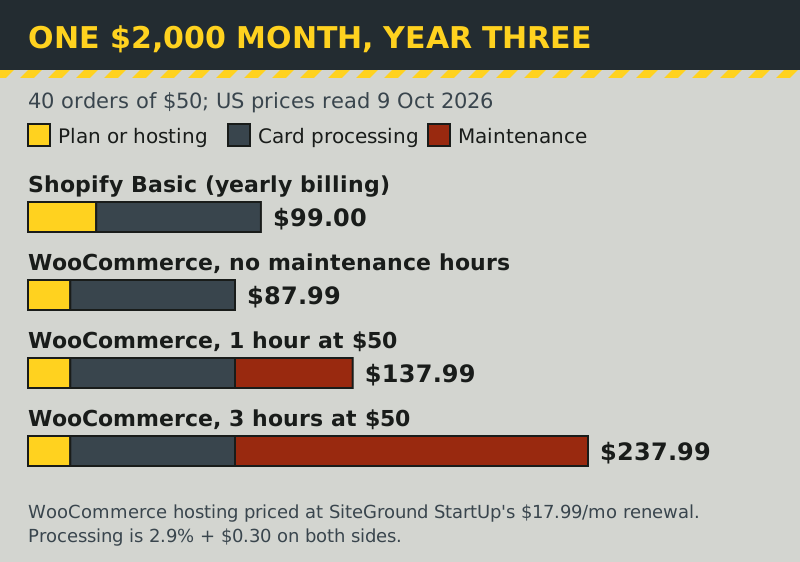
Priced at $50 an hour, one hour a month turns WooCommerce's $87.99 into $137.99, and three hours into $237.99. Against Shopify's $99.00, the owned store only wins if the upkeep is nearly free to you.
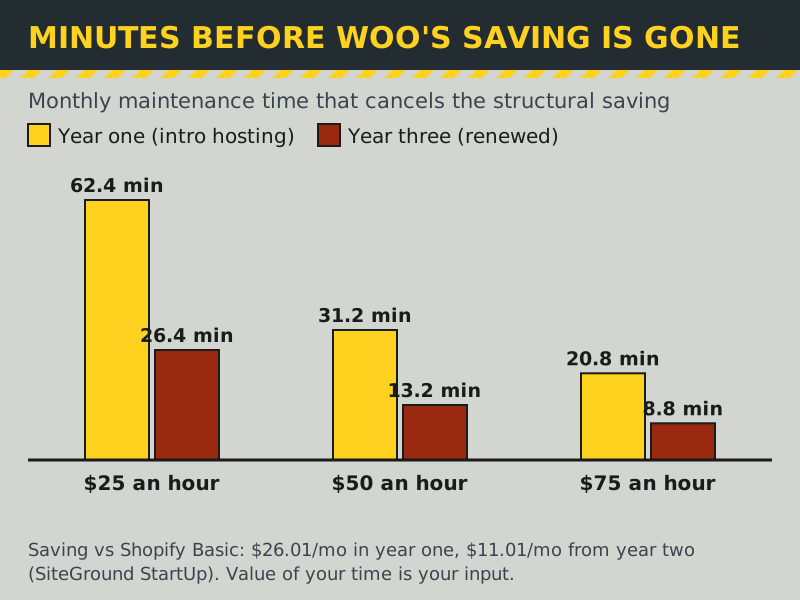
The second chart turns that into a threshold. At $50 an hour, WooCommerce's year-one saving of $26.01 a month buys 31 minutes of maintenance; the renewed saving of $11.01 buys 13. If your store needs more of your time than that, Shopify is the cheaper ledger, whatever the sticker says. If a developer already looks after your WordPress site, or you genuinely enjoy the work, the hours cost you little and Woo's saving is real.
Payments: identical rates, different penalties
On a standard US card, the two charge exactly the same: 2.9% + $0.30. The differences sit at the edges. Shopify Basic adds 2% on any order taken through a third-party gateway, which on a $2,000 month is $40. WooCommerce has no such surcharge; you can use WooPayments, Stripe or any other gateway on equal terms. On the other side, WooPayments adds 1.5% for international cards and 1% when it converts currency, and instant payouts cost 1.5% of the amount.
If you are tied to a gateway Shopify does not run, that 2% decides the question before hosting does. If you sell mostly to domestic buyers on standard cards, the two processors are a wash. Our transaction fees comparison sets these rates against six more builders.
Control versus convenience
What WooCommerce buys that no Shopify plan sells is ownership: your database, your checkout, your server, no plan ceiling and an exit that means copying files to another host. Shopify's convenience comes with terms: its payments or the 2% penalty, the theme system's boundaries, and no staff accounts on Basic. Add a second person and Shopify moves you to Grow at $79 a month on yearly billing, which widens Woo's saving by $50 a month at once.
What Shopify buys that WooCommerce cannot is someone else carrying the pager. Uptime, security, payment compliance and checkout all sit inside the plan fee. For a store with no technical help, that is the line worth paying for.
Apps and extensions: both platforms bill you twice
Neither sticker covers a full store. Shopify's second bill arrives monthly through apps, and what it comes to depends entirely on which ones the store installs. WooCommerce's arrives yearly through paid extensions, which its own pricing page puts at $29 to $299 a year each: Shipment Tracking is $59, Product Add-Ons $79, Bookings $249 and Subscriptions $279. Both lines vary too much by store to price in our receipt, so check what your own stack needs before treating either platform as the cheap one.
Who should pick which
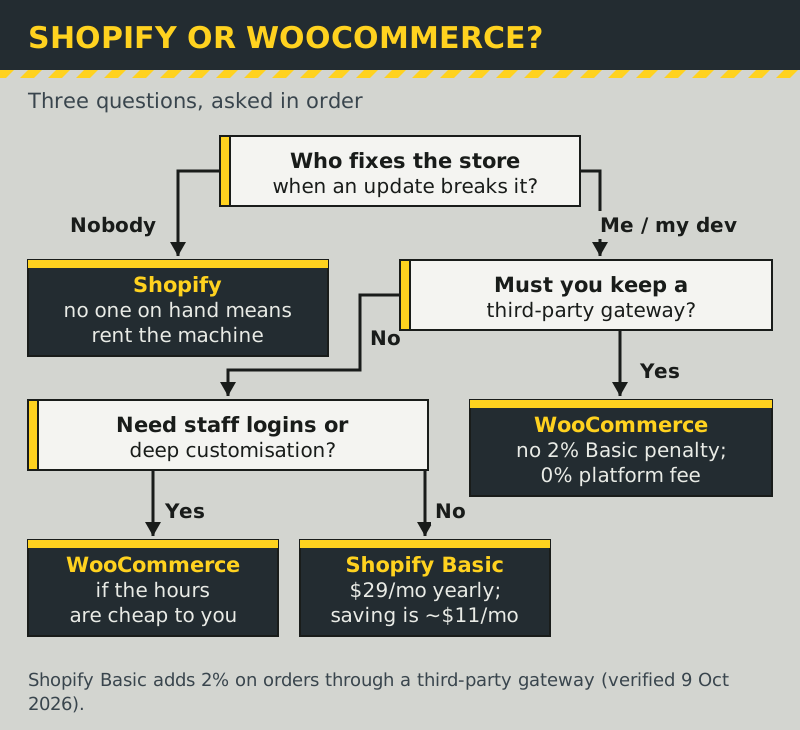
Pick WooCommerce if a maintainer is already on hand (hired, in-house or in the mirror), if you must keep a gateway Shopify would surcharge, or if you need staff logins and customisation that would push Shopify up a plan. Pick Shopify if you are anyone else: an $11-a-month saving is the cheapest insurance you will ever decline. In our ranking of the best ecommerce website builders, Shopify holds first at 9.3 and WooCommerce fourth at 7.9.
Rent the machine at Shopify, or price your own hours honestly and build the owned one with WooCommerce. Either entry balances, provided you booked the hours column before signing.
Itemized questions
Is WooCommerce cheaper than Shopify?
How much does WooCommerce cost compared to Shopify per year?
Does WooCommerce charge transaction fees?
Are Shopify's and WooCommerce's transaction fees the same?
When does WooCommerce stop being cheaper than Shopify?
Balance this against the field: the best ecommerce website builders, ranked, or run your own numbers in the fees calculator.